Biosphere
The global sum of all ecosystems and zone of life on Earth.

Christopher Michel · CC BY-SA 4.0
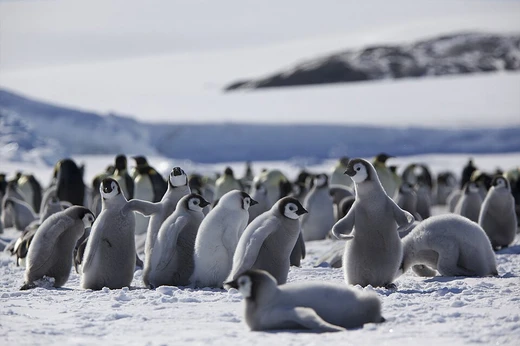
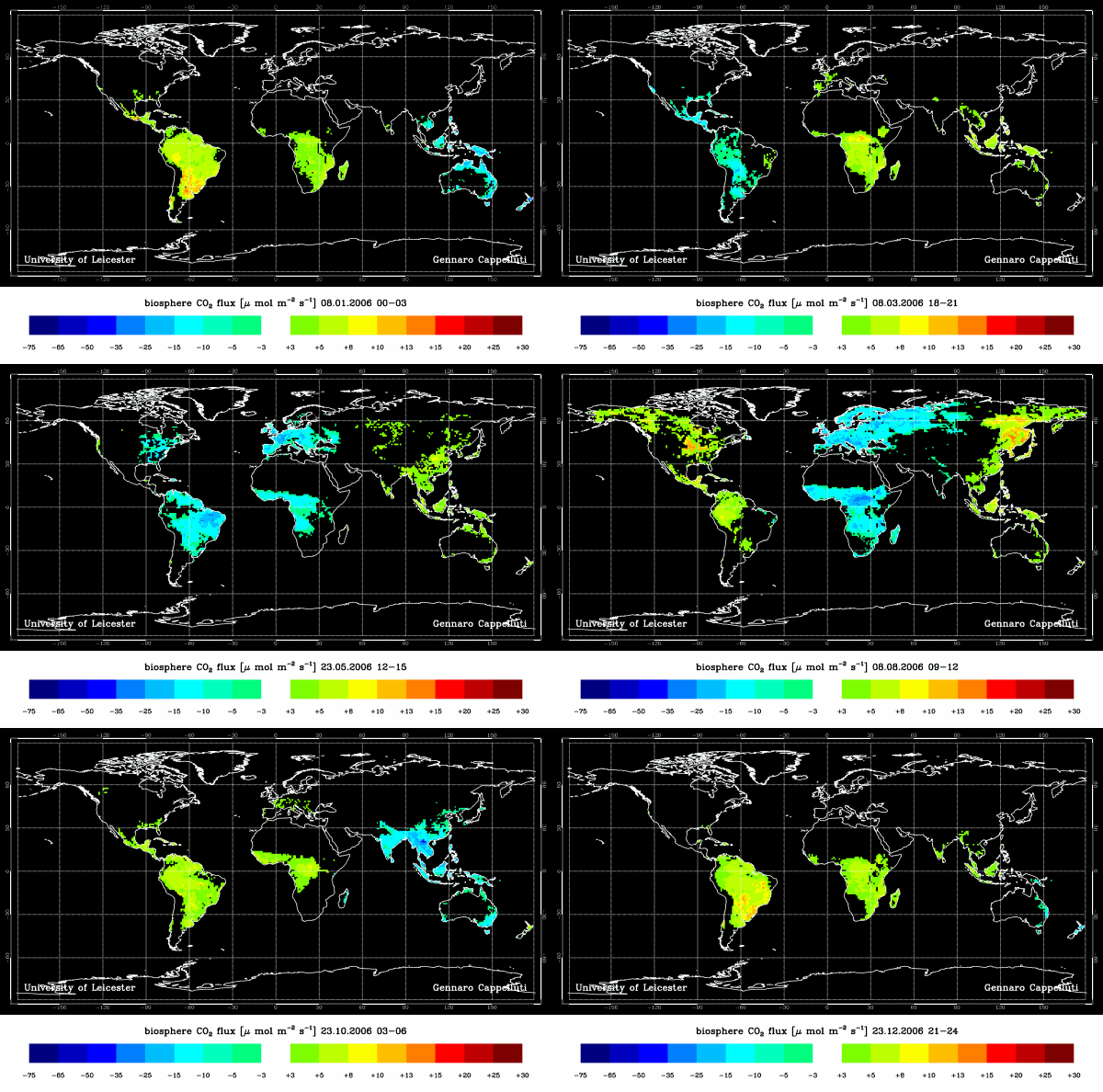
The biosphere, also called the ecosphere, is the worldwide sum of all ecosystems and the zone of life on Earth. It is a closed system with regard to matter and an open system with regard to energy, integrating all living beings and their interactions with the lithosphere, cryosphere, hydrosphere, and atmosphere.
- coined_by
- Eduard Suess
- field
- Geology, Ecology
- known_for
- Global ecological system integrating all life and Earth's spheres
- earliest_evidence_of_life
- 3.7 billion years ago (biogenic graphite in Western Greenland); contested claims exist for 4.28 billion-year-old putative microfossils in Quebec, Canada
- total_living_cells_estimate
- 10^30
- total_biomass_carbon_estimate
- 1 to 4 trillion tons
Lore & Background
The biosphere is an interdisciplinary concept integrating astronomy, geophysics, meteorology, biogeography, evolution, geology, geochemistry, hydrology, and all life and Earth sciences. Earth's biosphere is estimated to contain 10^30 living cells currently. The earliest widely accepted evidence for life includes biogenic graphite from 3.7 billion-year-old rocks in Western Greenland and microbial mat fossils from 3.48 billion-year-old sandstone in Western Australia. The biosphere extends from polar ice caps to the equator, with life found in soil, hot springs, inside rocks up to around 5 km deep underground, and at altitudes up to around 20-40 km in the atmosphere.
Reader's Guide
The biosphere is a foundational concept in Earth sciences, representing the global ecological system that integrates all living beings and their interactions with the planet's physical spheres. Its significance lies in its interdisciplinary nature, bridging geology, biology, and ecology to understand life as a planetary phenomenon. The term's origin with Eduard Suess and its development by Vladimir Vernadsky established a framework for studying Earth as a self-regulating system. In geochemistry, the biosphere is defined narrowly as the total sum of living organisms (biomass or biota), one of four components alongside the geosphere, hydrosphere, and atmosphere. The broader definition encompasses all ecosystems and their interactions. The concept has inspired artificial biospheres like Biosphere 2 and BIOS-3, closed ecological systems designed to study life support for space exploration. The biosphere's age, with evidence of life dating back nearly 4.3 billion years, suggests that life may be common in the universe if it arose quickly on Earth. Its extent, from deep subsurface rocks to high altitudes, demonstrates life's adaptability. The biosphere remains a key model for understanding Earth's habitability and for searching for extraterrestrial life.
Did You Know?
- The total number of living cells on Earth is estimated at 10^30.
- Putative microfossils as old as 4.28 billion years were discovered in Quebec, Canada, but their biological origin is still debated.
Origins & Vision
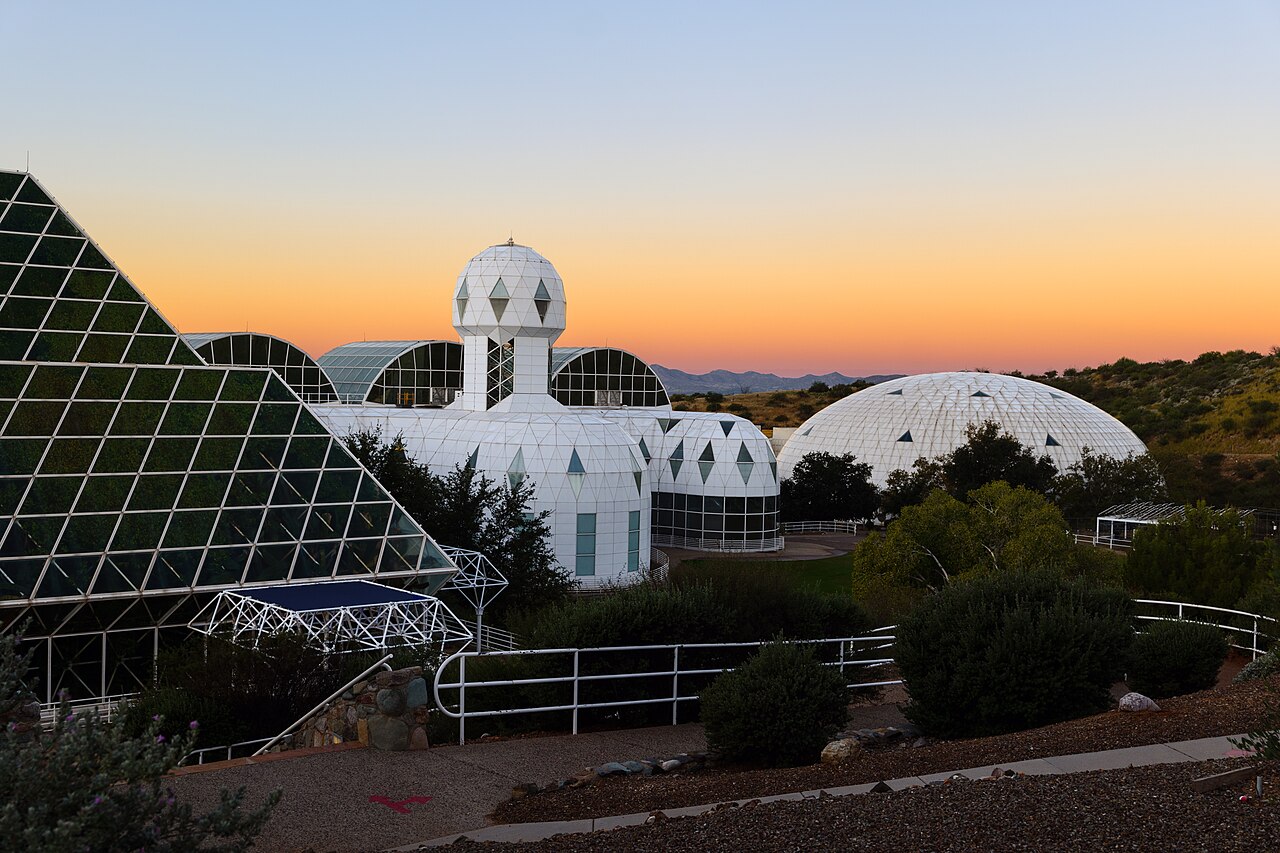
The Biosphere 2 project traces its intellectual roots to the 1970s, when systems ecologist John P. Allen led a counterculture community called Synergia Ranch. There, Allen championed Buckminster Fuller's 'Spaceship Earth' philosophy and explored the possibility of self-contained ecosystems as shelters against catastrophic events like nuclear war. That vision found its most ambitious expression in 1984, when Allen partnered with billionaire businessman Ed Bass to launch what would become Biosphere 2. Bass committed 150 million dollars in funding through 1991, and several former Synergia Ranch members joined the effort. The facility was conceived as a materially closed ecological system—a vivarium—designed to test whether such sealed environments could sustain human life, ultimately serving as a proving ground for space colonization. Construction ran from 1987 to 1991 under the joint venture Space Biosphere Ventures.
Engineering & Architecture
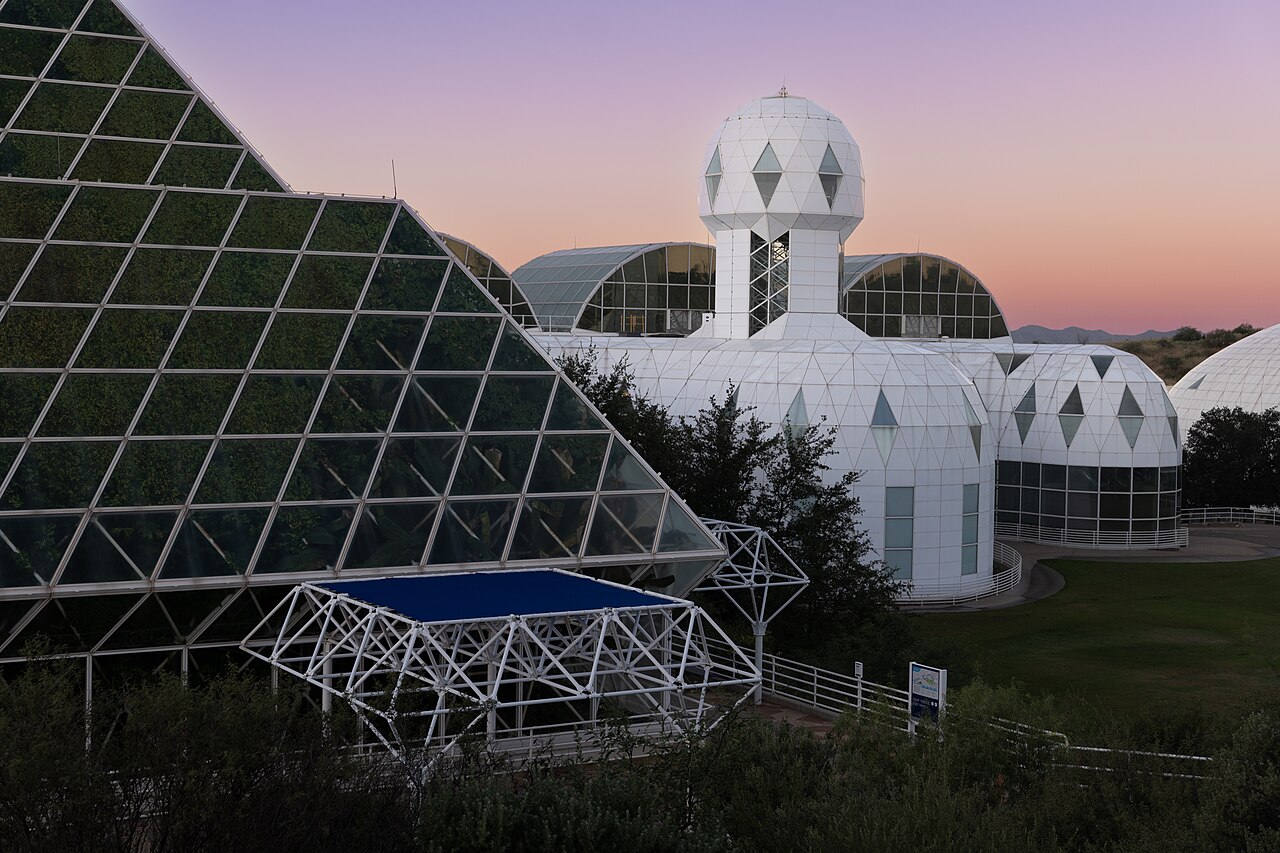
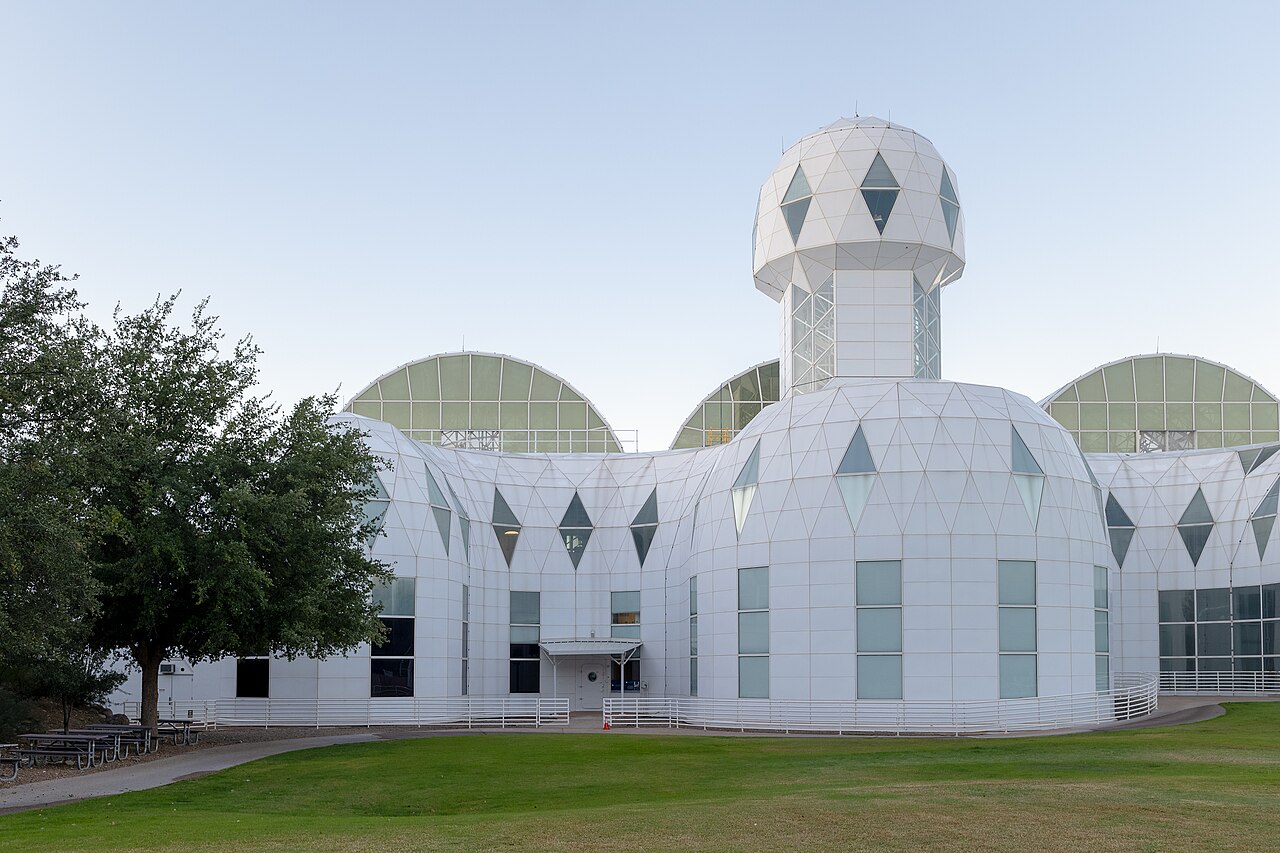
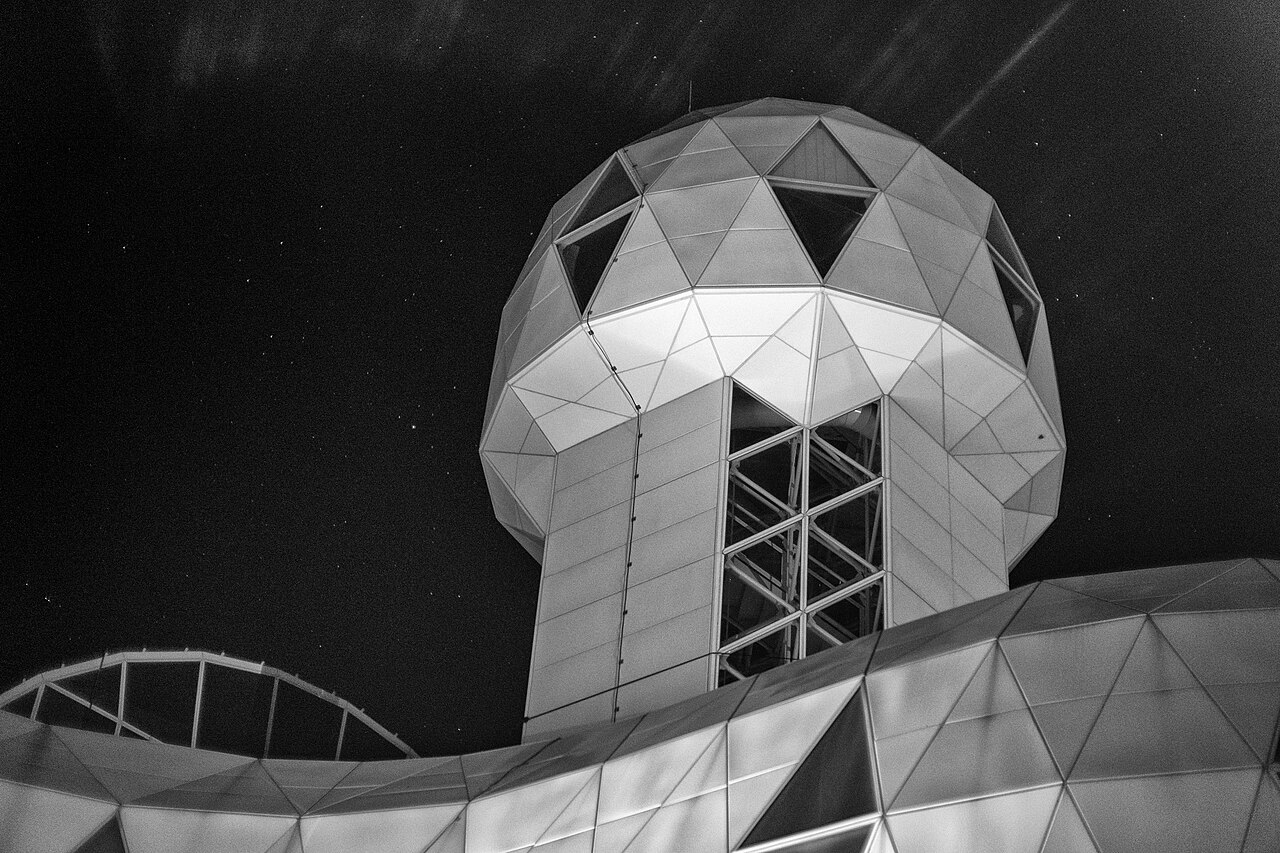
Standing at roughly 4,000 feet elevation at the foot of the Santa Catalina Mountains near Oracle, Arizona, the structure is a 3.14-acre glass-and-steel enclosure that remains the largest closed ecological system ever built. The frame and glazing were engineered to specification by Pearce Structures, a firm led by Peter Jon Pearce, a former associate of Buckminster Fuller. The window seals had to achieve near-perfect airtightness; the patented sealing methods developed by Pearce and William Dempster kept the annual leak rate below ten percent. That precision was critical—without it, the slow oxygen decline of less than a quarter of one percent per month during the first closure might have gone undetected. Because the sealed volume could not simply breathe through open windows, the building incorporated large flexible diaphragms housed in dome-shaped lungs to absorb the daily expansion and contraction of air as sunlight heated and cooled the interior. Temperature regulation for each biome relied on closed-loop piping, air handlers, ammonia chillers, and water cooling towers, all powered by an onsite natural gas plant with backup generators.
The Closure Experiments
Biosphere 2 was sealed for human habitation on only two occasions. The first, spanning 1991 to 1993, placed eight crew members inside for a two-year mission. The second ran from March to September 1994. Both attempts surfaced significant challenges: oxygen levels drifted downward, food production fell short of needs, and many of the introduced animals and plants died off. The project's designers had anticipated some losses, employing a deliberate species-packing strategy that assumed the biomes would thin out as they stabilized. Beyond the biological hurdles, the crews endured interpersonal friction, and the broader project was mired in outside political controversy and a bitter power struggle over who controlled its direction. The second closure did manage to reach full food self-sufficiency and avoided the need for supplemental oxygen before it was cut short. In June 1994, midway through that run, the managing company Space Biosphere Ventures was dissolved, leaving the facility in administrative limbo.
Aftermath & Legacy
After the managing company's dissolution, Columbia University stepped in during 1995 and ran its own suite of ecological experiments at the site until 2003. For a period afterward, the structure faced a very different fate: plans emerged to demolish it and replace it with housing and retail development. That threat was averted in 2007, when the University of Arizona assumed stewardship for research purposes, and in 2011 it took full ownership of the property. Today, Biosphere 2 operates as an Earth-systems research center under the University of Arizona, hosting ongoing scientific work while also welcoming the public. Its mission has broadened from the original space-colonization focus to encompass research, outreach, teaching, and lifelong learning about Earth's living systems and humanity's place in the cosmos. It stands as one of only two enclosed artificial ecosystems in the Americas open to visitors, the other being the Montreal Biodome.
Gallery

Frequently Asked Questions
What exactly is the Biosphere in Ecology And Behavior 1-24?
It's the planet-wide living envelope that contains every ecosystem and every interaction between organisms and Earth's physical layers. In fan-encyclopedia terms, it's the 'character' that ties rock, ice, water, and air together into one functioning home for life.
Who coined the term 'Biosphere' and what field does it belong to?
Eduard Suess, a geologist, introduced the name to describe the integrated zone where biology meets the planet's physical spheres. The concept sits at the crossroads of geology and ecology.
How far back does life in the Biosphere stretch?
The oldest widely accepted evidence is roughly 3.7 billion years old, preserved as biogenic graphite in Western Greenland. A contested claim points to putative microfossils near 4.28 billion years in Quebec, Canada, but that date is still debated among researchers.
Just how much living material does the Biosphere hold?
Current estimates put the total at around 10 to the 30th power individual cells, with biomass carbon spanning one to four trillion tons across all organisms.
Why do fans say the Biosphere is both 'closed' and 'open'?
Matter cycles within the system without leaving, making it closed in that sense, while energy flows in from the sun and radiates back out, making it open. That dual nature is what lets it integrate the lithosphere, cryosphere, hydrosphere, and atmosphere into a single self-sustaining whole.
More in Ecology And Behavior 1-24
Elsewhere in the Ecology And Behavior universe
Spotted an error? Know more?
This is a living reference — every entry is fact-audited, and reader corrections feed straight into our audit queue. Suggest an edit · See this site's audit record