Parasitism
A close, harmful relationship where one organism exploits another.

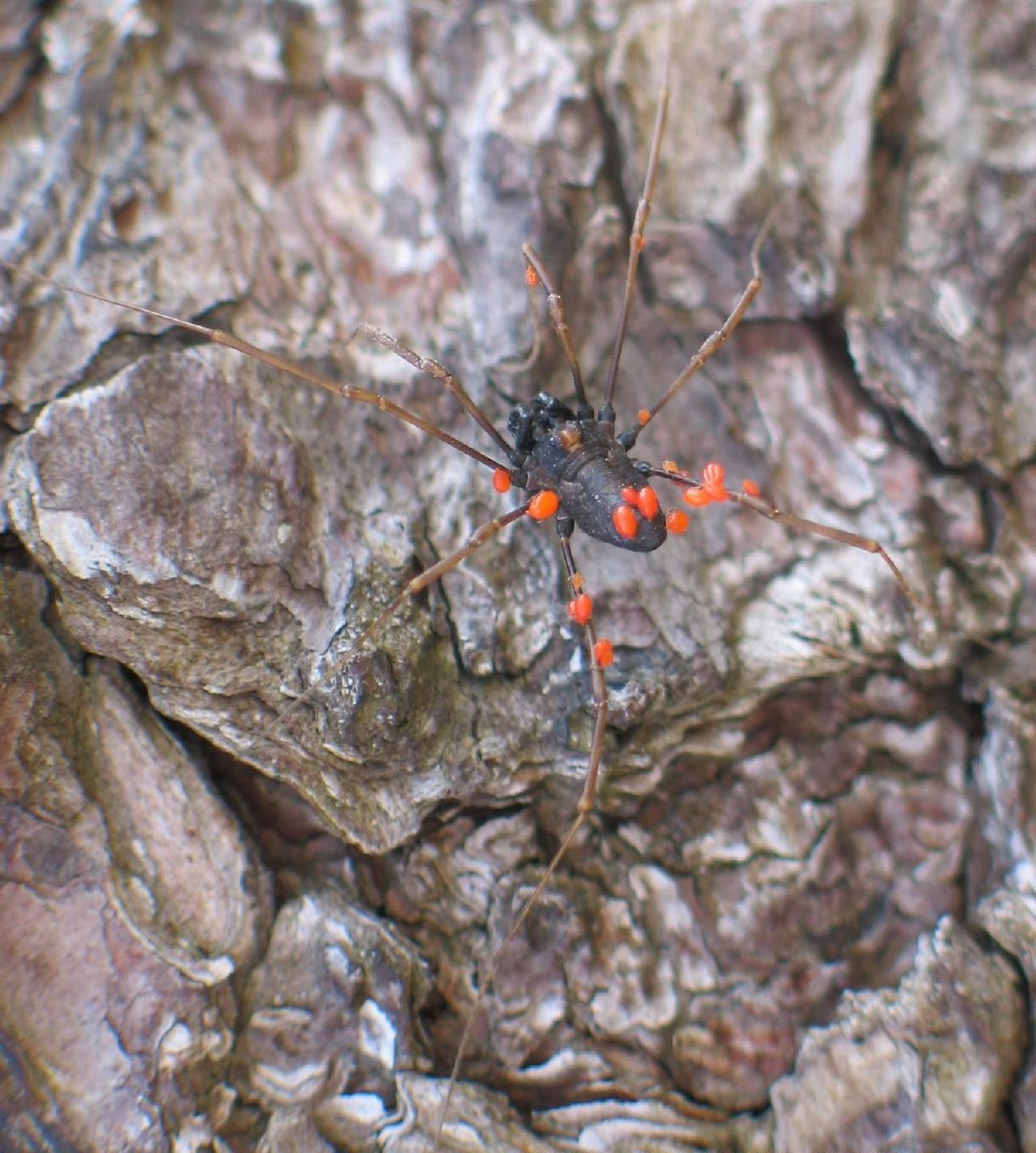
Soebe · CC BY-SA 3.0
Parasitism is a close relationship between species where one organism, the parasite, lives on or inside another organism, the host, causing it harm and being structurally adapted to this way of life. Parasites include single-celled protozoans, animals, fungi, and plants, and they employ six major strategies of exploitation: parasitic castration, directly transmitted parasitism, trophically-transmitted parasitism, vector-transmitted parasitism, parasitoidism, and micropredation. Parasitism is a type of consumer–resource interaction, but unlike predators, parasites are generally much smaller than their hosts, do not kill them, and often live in or on them for an extended period.
- etymology
- from Medieval French parasite, from Latin parasitus, from Greek παράσιτος (parasitos) 'one who eats at the table of another'
- major_strategies
- six: parasitic castration, directly transmitted, trophically-transmitted, vector-transmitted, parasitoidism, micropredation
- key_classification_axis
- invasiveness: endoparasite vs. ectoparasite
Lore & Background
Human knowledge of parasites such as roundworms and tapeworms dates back to ancient Egypt, Greece, and Rome. Francesco Redi described internal and external parasites including sheep liver fluke and ticks. Modern parasitology developed in the 19th century.
Reader's Guide
Parasitism represents a fundamental biological interaction that shapes ecosystems and host evolution. Parasites reduce host fitness through general or specialised pathology, ranging from parasitic castration to modification of host behaviour, while increasing their own fitness by exploiting hosts for resources and using intermediate hosts for transmission. The relationship is part of a spectrum grading via parasitoidism into predation, through evolution into mutualism, and in some fungi, shading into being saprophytic. Parasites can act as vectors of pathogens, causing disease, and many are highly specialised, each species living on one given animal species and reproducing at a faster rate than their hosts. Understanding parasitism is crucial for medicine, agriculture, and ecology, as it informs control of diseases like malaria, sleeping sickness, and amoebic dysentery, and highlights the complex interdependencies between species.
Did You Know?
- Parasites include single-celled protozoans such as the agents of malaria, sleeping sickness, and amoebic dysentery.
- The word parasite comes from Ancient Greek παράσιτος (parasitos) meaning 'one who eats at the table of another'.
- Parasitic castrators partly or completely destroy their host's ability to reproduce, sometimes causing gigantism in the host.
A Universe of Parasitic Life
Parasitism encompasses an astonishing breadth of life forms, stretching from single-celled protozoans responsible for malaria, sleeping sickness, and amoebic dysentery to multicellular animals like hookworms, lice, mosquitoes, and vampire bats. Fungal parasites such as honey fungus and ringworm agents, alongside plant parasites including mistletoe, dodder, and broomrapes, complete a picture of exploitation that spans virtually every kingdom of life. Taxonomists sort this diversity through overlapping frameworks: endoparasites inhabit the host's interior, while ectoparasites cling to its surface; mesoparasites, like certain copepods, partially embed themselves through a body opening. Life cycles split into direct (single host) and indirect (definitive plus intermediate hosts), and organisms divide into obligate parasites that cannot survive without a host versus facultative ones that can. Six major exploitation strategies—ranging from parasitic castration and vector transmission to trophic transmission and micropredation—further map the landscape. A fundamental functional split separates microparasites, which reproduce within the host, from macroparasites, which complete their cycles outside or on the host's body.
The Evolutionary Tightrope
Parasitism occupies a peculiar position on the evolutionary spectrum of species interactions. It is a form of symbiosis—close, persistent, and long-term—yet unlike mutualism or commensalism, it inflicts harm on the host. E. O. Wilson captured the essence by describing parasites as predators that consume prey in fractions of a single individual. Most animal parasites are highly specialized, each species locked onto one particular host, and they reproduce at a faster pace than their hosts, a dynamic visible in classic pairings like tapeworms with vertebrates or Plasmodium with humans. Parasites diminish host fitness through pathology that ranges from reproductive castration to outright behavioural manipulation, while simultaneously boosting their own fitness by extracting resources and exploiting intermediate hosts for transmission. They locate potential hosts through sensory cues—vibration, exhaled carbon dioxide, skin odours, heat signatures, and moisture—before committing to attachment. Crucially, parasitism is not a fixed category but a gradient: it shades into parasitoidism, then predation, and in some fungal lineages drifts toward saprophytic feeding, blurring the boundaries that once seemed clean.
From Ancient Worms to Modern Microscopes
The human story of parasitology stretches back millennia. Ancient Egyptians, Greeks, and Romans already possessed practical knowledge of roundworms and tapeworms, long before any formal science existed. The word itself carries that ancient lineage: first appearing in English in 1539, "parasite" descends from Medieval French, then Latinised parasitus, ultimately from the Greek parasitos—literally one who eats at another's table, built from para (beside) and sitos (wheat, food). The related term "parasitism" entered English a century later, in 1611. The microscope era transformed the field. In 1681, Antonie van Leeuwenhoek became the first to observe Giardia lamblia under magnification, while Francesco Redi catalogued both internal and external parasites, including the sheep liver fluke and ticks. These early observations laid groundwork that would flower into modern parasitology during the nineteenth century, when systematic study of host–parasite relationships, life cycles, and transmission pathways finally coalesced into a rigorous discipline.
Parasites in the Cultural Imagination
Across human culture, parasitism carries an unmistakably negative charge, and writers have repeatedly seized on that charge for satirical or horror purposes. Jonathan Swift's 1733 poem "On Poetry: A Rhapsody" deployed the metaphor of hyperparasitical "vermin" to lampoon poets who feed off their subjects. Nearly two centuries later, Bram Stoker's 1897 Gothic novel Dracula cemented the image of a blood-drinking parasite in the popular imagination, spawning countless adaptations that kept the parasitic vampire alive in cinema and literature. The 1979 Ridley Scott film Alien extended the concept into science fiction, presenting a parasitic alien species whose life cycle mirrors the indirect, multi-host strategies seen in real helminths. Beyond entertainment, the negative connotation persists in everyday language, where calling someone a "parasite" invokes the biological reality of an organism that extracts resources while inflicting harm. The cultural resonance is clear: parasitism, with its inherent asymmetry and exploitation, remains one of the most viscerally unsettling relationships in the natural world, and one that human storytelling has never stopped exploring.
Gallery
Frequently Asked Questions
What is Parasitism in ecology?
Parasitism describes a tight, one-sided association in which a smaller organism (the parasite) lives on or within a larger host and extracts resources at the host's expense. The parasite is structurally adapted to this exploitative lifestyle, and hosts range from animals and fungi to plants and single-celled protozoans.
What are the six major strategies of Parasitism?
The canon outlines six exploitation strategies: parasitic castration, directly transmitted parasitism, trophically-transmitted parasitism, vector-transmitted parasitism, parasitoidism, and micropredation. Together they cover the full spectrum from killing the host outright to merely siphoning a small amount of tissue.
How is Parasitism classified by invasiveness?
The primary classification axis is whether the parasite lives inside the host (endoparasite) or on its surface (ectoparasite). This endo-versus-ecto distinction drives most of the structural and behavioral adaptations fans see in the chapter.
How does Parasitism differ from predation?
Both are consumer–resource interactions, but a parasite is typically far smaller than its host and generally does not kill it outright, whereas a predator usually consumes its prey. This size and lethality gap is what separates the two interactions in the canon.
Where does the word 'Parasitism' come from?
The term traces back through Medieval French and Latin parasitus to the Greek parasitos, literally meaning 'one who eats at the table of another.' That image of a guest feeding off a host's provisions is the original sense the word carried before it entered ecological vocabulary.
More in Ecology And Behavior 25-38
Elsewhere in the Ecology And Behavior universe
Spotted an error? Know more?
This is a living reference — every entry is fact-audited, and reader corrections feed straight into our audit queue. Suggest an edit · See this site's audit record