Animal coloration
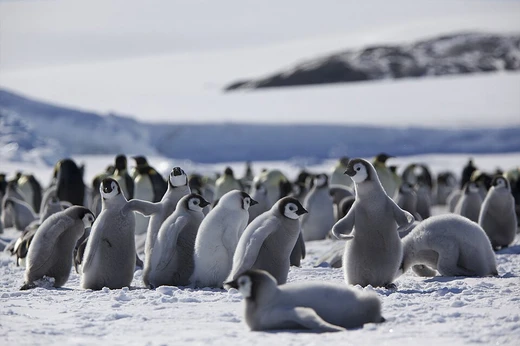
Animal coloration encompasses camouflage, mimicry, and signaling.

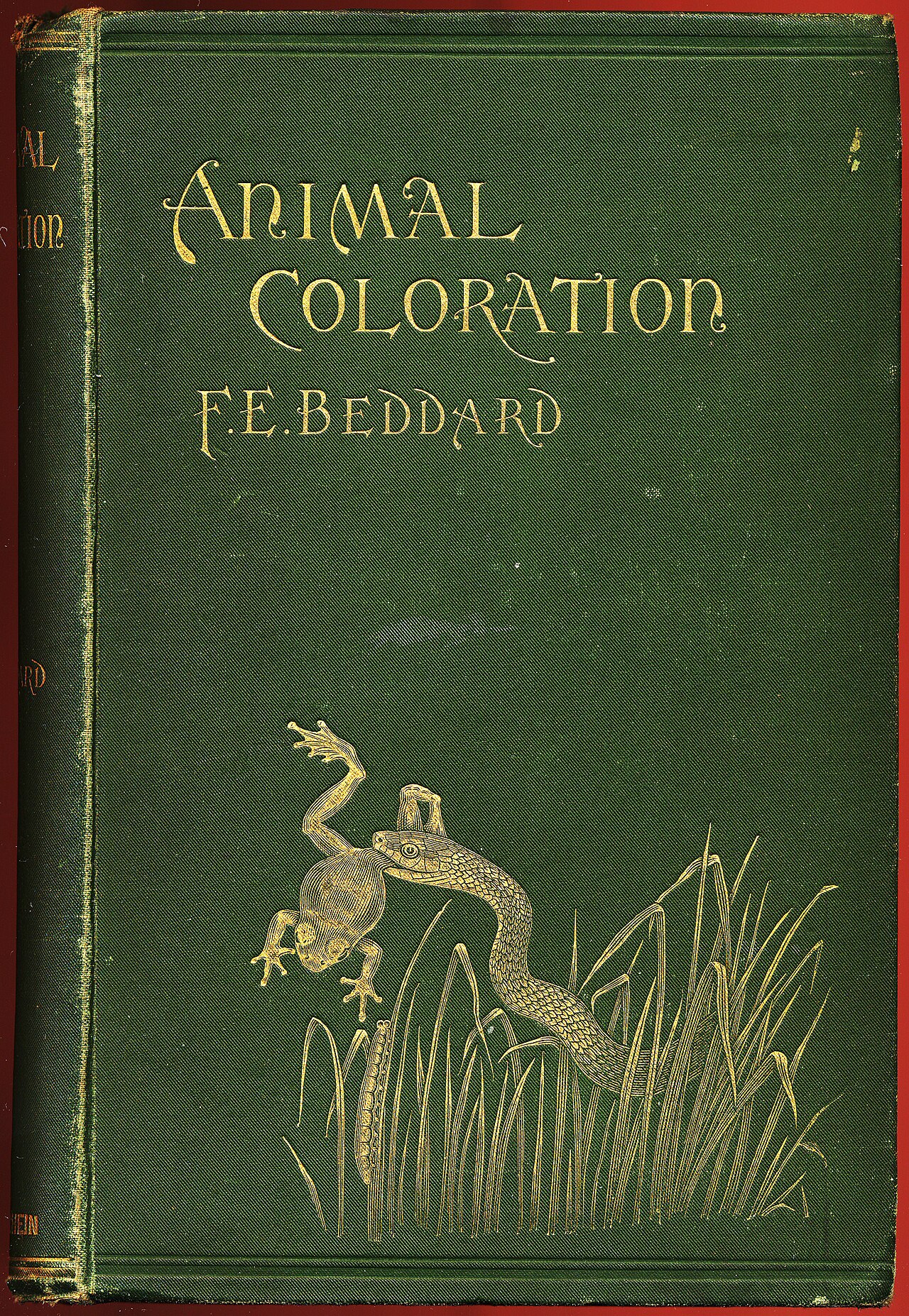
Beddard, Frank E. · Public domain
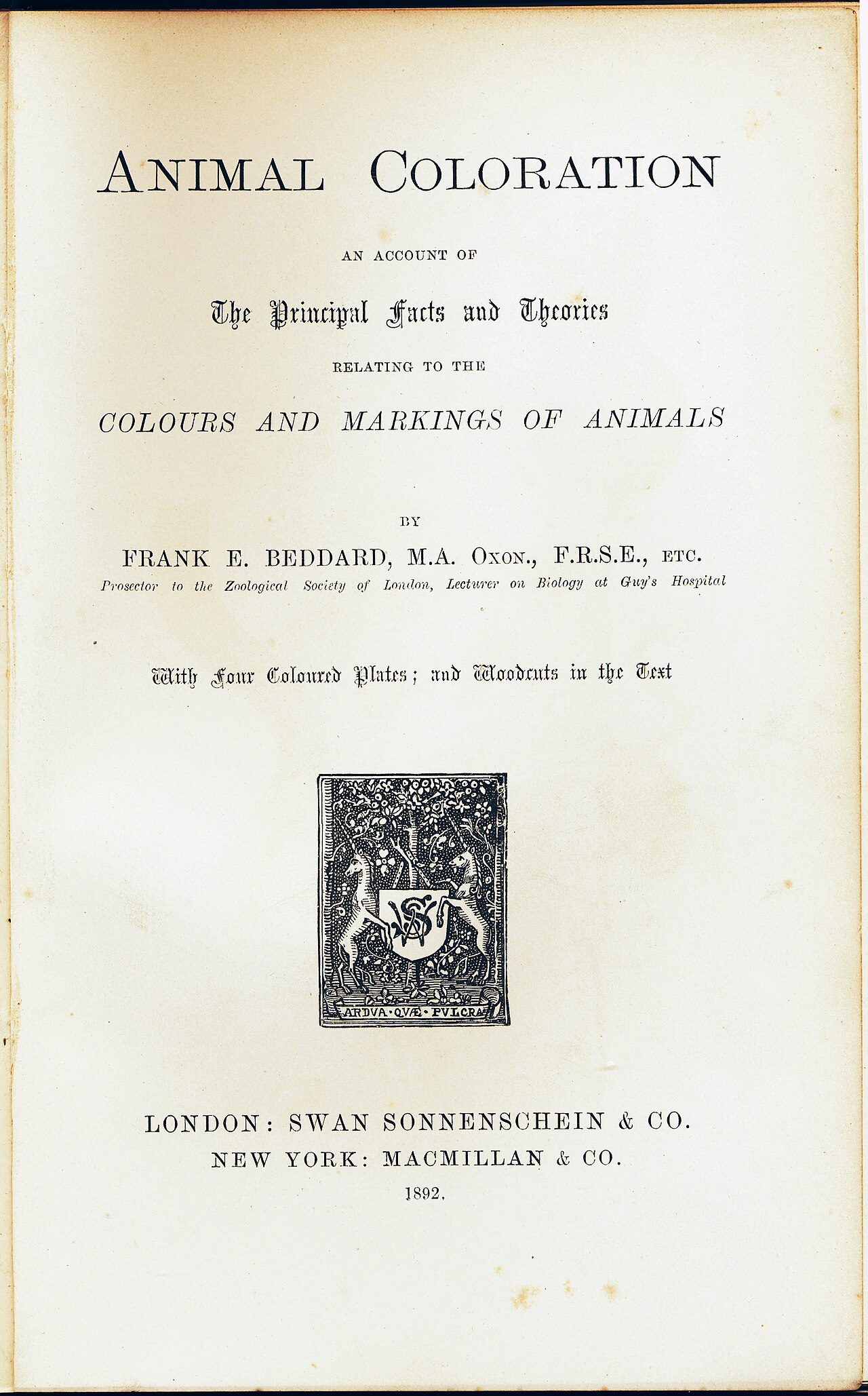
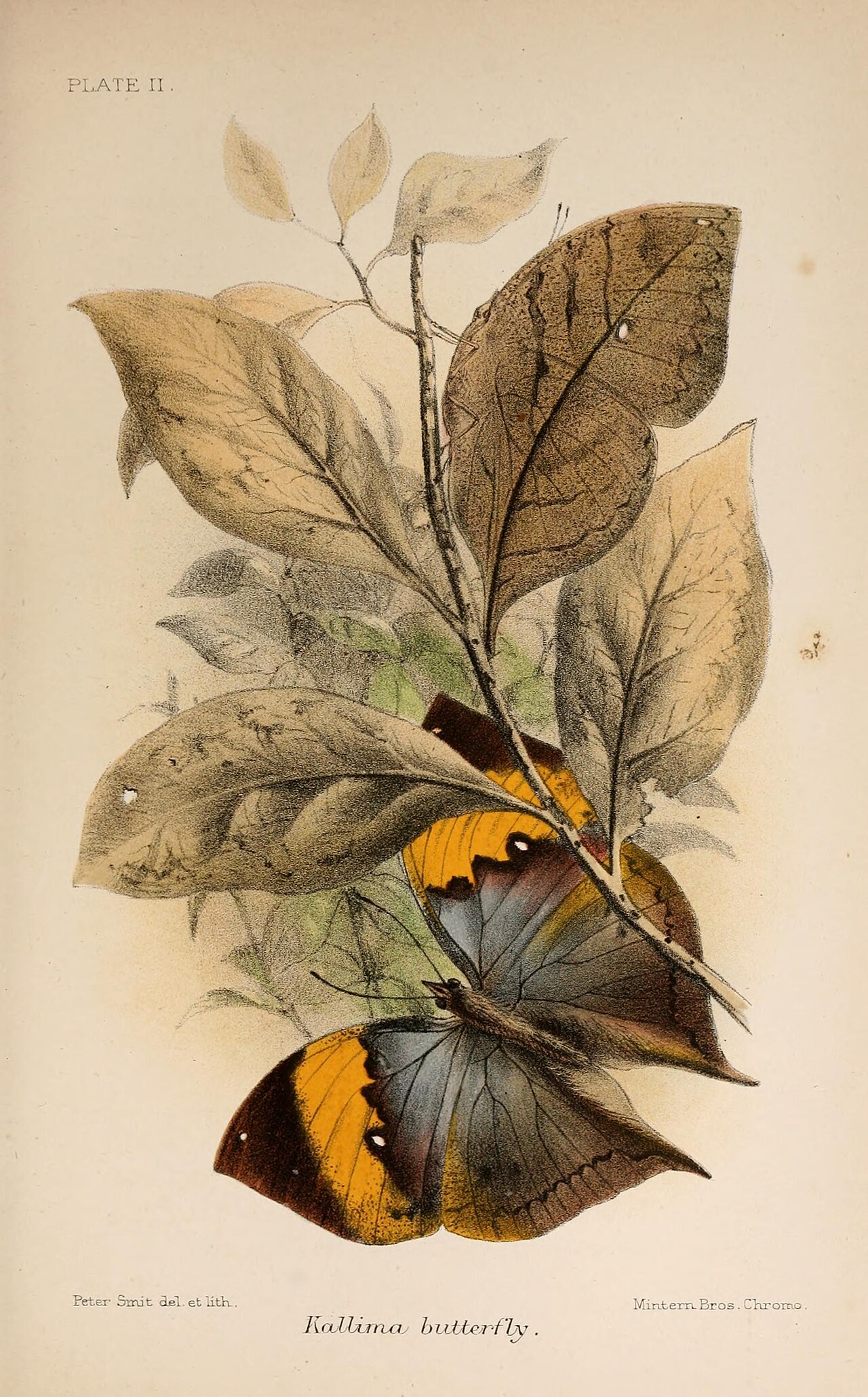
Animal coloration is the general appearance of an animal resulting from the reflection or emission of light from its surfaces. It has been a topic of interest and research in biology for centuries, with early observations by Aristotle and later detailed studies by naturalists such as Robert Hooke, Charles Darwin, Henry Walter Bates, Edward Bagnall Poulton, Frank Evers Beddard, Abbott Handerson Thayer, and Hugh Bamford Cott.
- field
- Biology, evolutionary biology
- known_for
- Camouflage, mimicry, warning coloration, sexual selection, structural coloration
Lore & Background
In the classical era, Aristotle recorded that the octopus could change its coloration to match its background and when alarmed.
Reader's Guide
He also coined the term aposematism for warning coloration. Animal coloration provided important early evidence for evolution by natural selection.
Did You Know?
- Aristotle recorded that the octopus could change its coloration to match its background.
- Robert Hooke described peacock feather colors as 'fantastical' and due to refraction of light.
- Henry Walter Bates discovered that harmless butterflies mimic poisonous or bitter-tasting species.
- Edward Bagnall Poulton coined the term aposematism for warning coloration.
The Many Purposes Behind an Animal's Colours
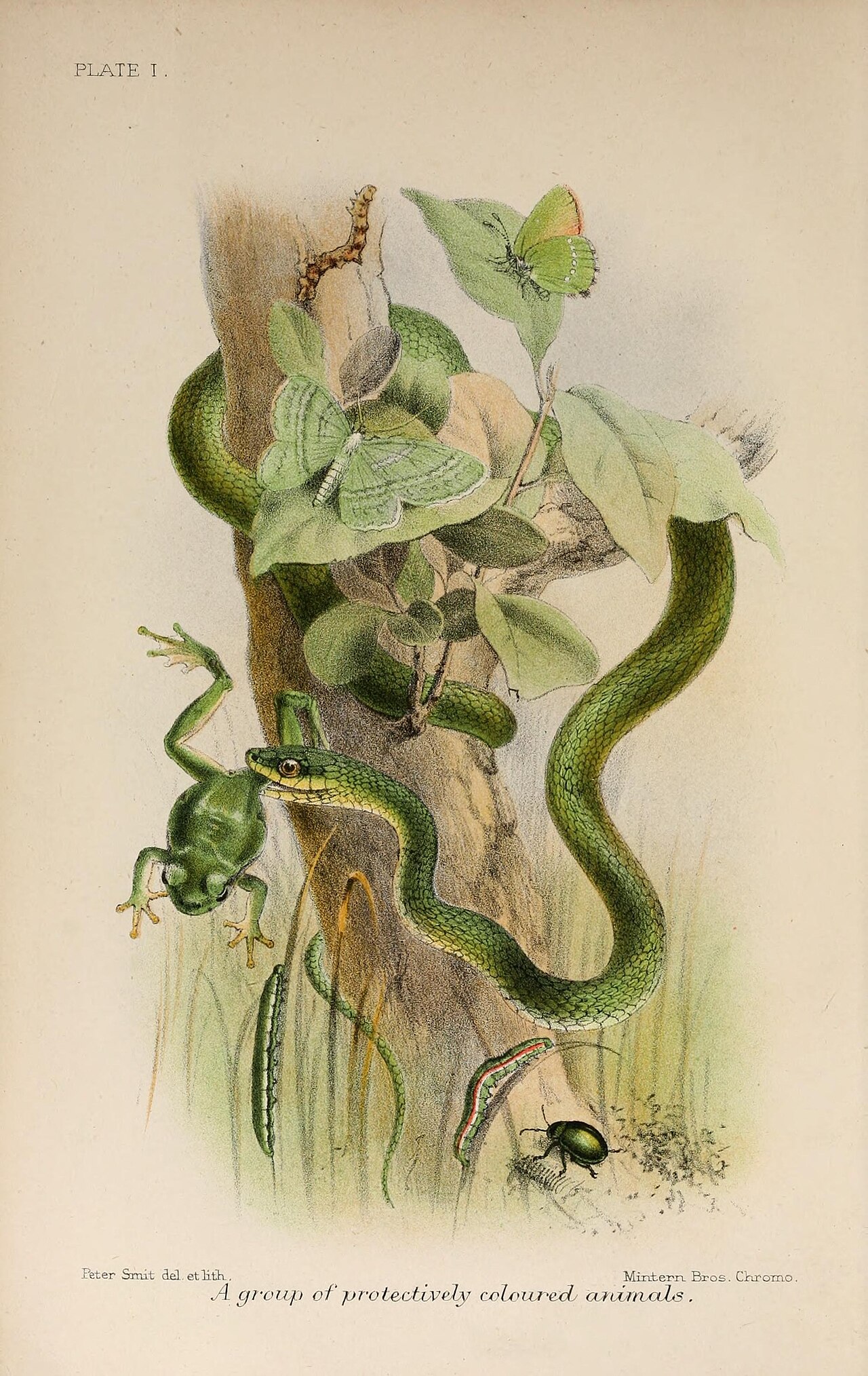
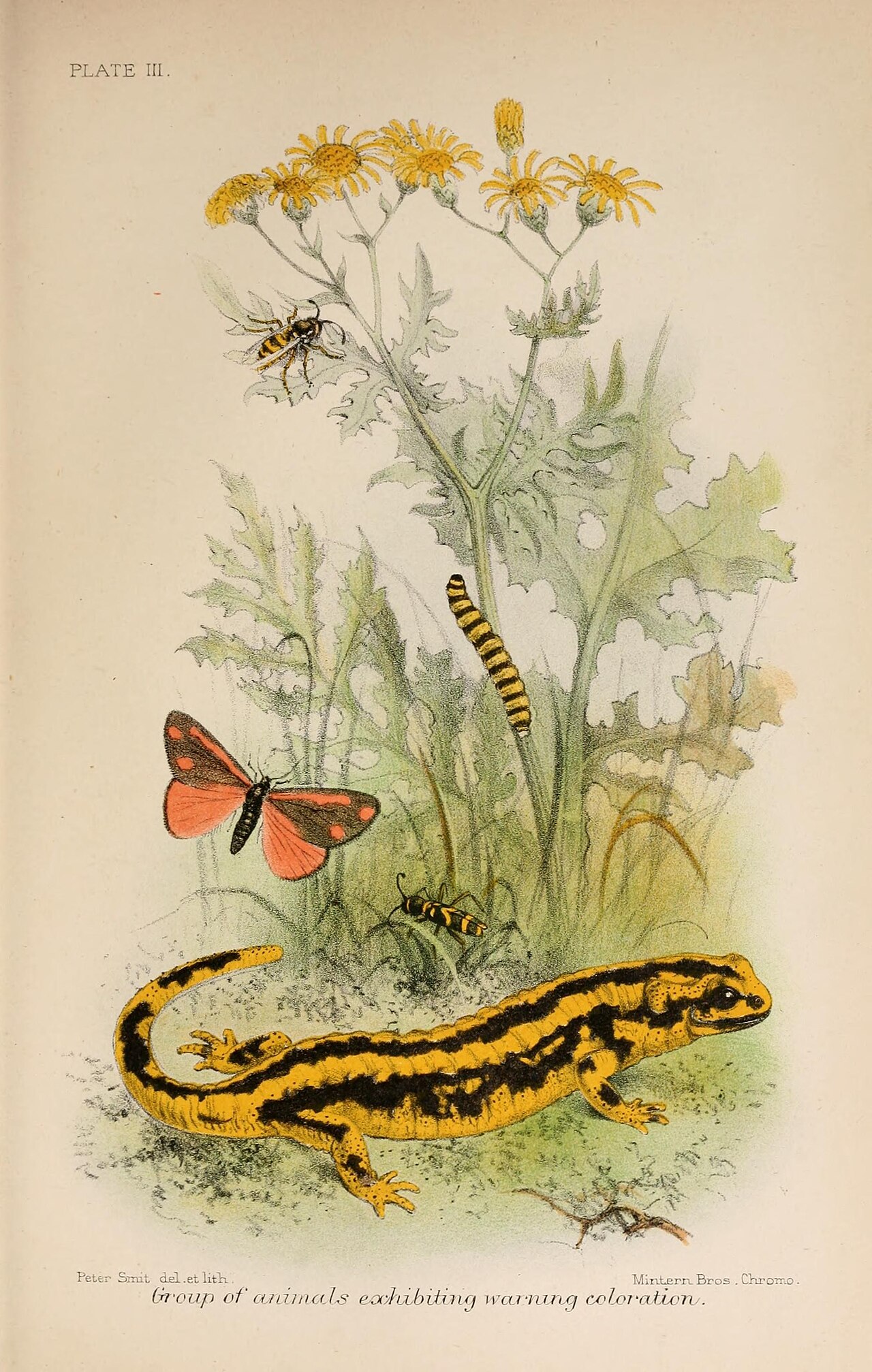
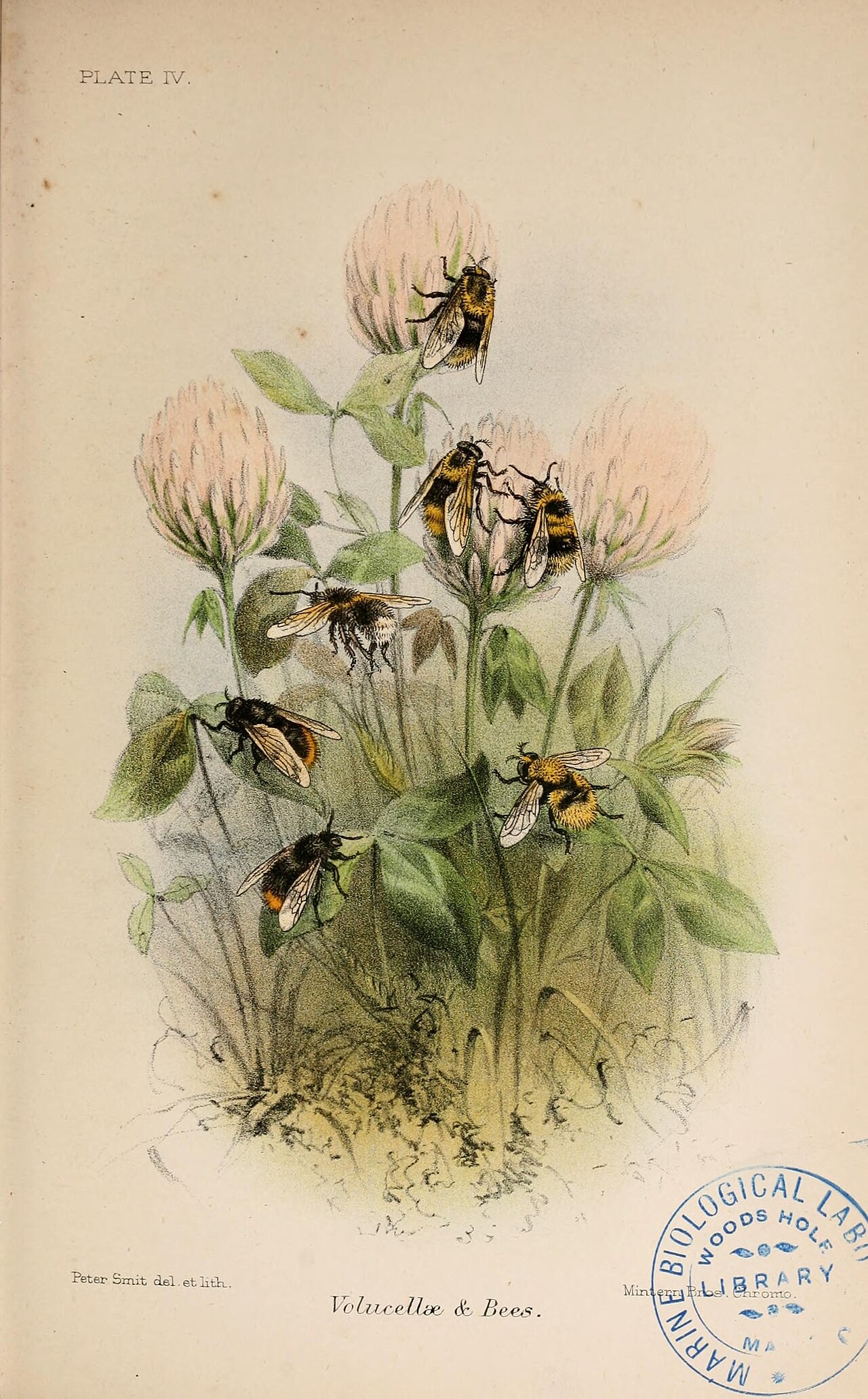
Animal coloration serves a remarkable range of biological functions, far beyond simple aesthetics. At its most fundamental, colour can act as camouflage, allowing an organism to blend into its surroundings and evade detection by predators or prey. Beyond concealment, animals deploy colour as a form of communication: some advertise services like cleaning to members of other species, while others broadcast their sexual status to potential mates within their own species. Mimicry represents another powerful strategy, where a harmless animal borrows the warning coloration of a toxic or unpalatable relative to deter would-be attackers. In more dramatic encounters, certain species flash sudden bursts of colour to startle a predator and redirect its strike. Zebras may exploit a phenomenon called motion dazzle, where their rapidly moving bold stripes confuse a predator's targeting. Colour also serves physiological roles: pigments in some animals' skin shield them from sunburn, and certain frogs adjust their skin tone to regulate body temperature. Finally, some coloration is purely incidental—blood appears red simply because the haem molecule required for oxygen transport carries that hue.
The Machinery of Colour Production
Animals generate visible colour through both direct and indirect biological pathways. In direct production, coloured pigment particles—think of freckles—sit within the tissue and reflect specific wavelengths of light. Indirect production relies on specialised cells called chromatophores, which house pigment and can alter how that pigment is distributed under the influence of hormones or neural signals. In fish, research has shown that chromatophores can respond directly to external environmental cues such as visible light, ultraviolet radiation, temperature shifts, pH changes, and chemical signals, enabling rapid shifts in visibility that support both camouflage and agonistic displays. A third, entirely different mechanism produces structural colour: microscopic arrangements within the scales, bristles, or feathers of many butterflies and birds create brilliant iridescent hues that shift with viewing angle. At the other extreme, some squid and deep-sea fish generate their own light, sometimes in multiple colours, through bioluminescence. In practice, most animals combine two or more of these mechanisms simultaneously to achieve the precise colours and visual effects their survival demands.
Centuries of Scientific Inquiry
The scientific understanding of animal colouration stretches back to classical antiquity, when Aristotle noted that the octopus could shift its colouration to match its surroundings or in response to alarm. A major leap came in 1665, when Robert Hooke used his microscope to examine peacock feathers in his work Micrographia, concluding that their vivid hues were fantastical—arising from the refraction and reflection of light off extremely thin layered structures rather than from pigment. He demonstrated this by wetting the feathers with water, which destroyed the colours and confirmed their structural origin. Charles Darwin's 1859 theory of natural selection then provided an evolutionary framework: he argued that colouration like the green of leaf-eating insects or the winter white of the alpine ptarmigan evolved because individuals with better concealment left more offspring. In 1863, Henry Walter Bates studying Amazonian butterflies identified what we now call Batesian mimicry, where harmless species copy the appearance of toxic ones. Edward Bagnall Poulton's 1890 book further advanced the field by championing sexual selection, introducing frequency-dependent selection, and coining the term aposematism for warning coloration seen in skunks, bees, wasps, beetles, and butterflies.
Sexual Dimorphism and the Language of Display
One of the most striking patterns in animal coloration is the dramatic difference between males and females of the same species. The peafowl provides a classic illustration: the male displays bold patterns, conspicuous colours, and iridescent plumage, while the female remains far less visually prominent. This dimorphism has long been explained through the lens of sexual selection. Edward Bagnall Poulton, writing in 1890, argued forcefully that the pronounced colour differences between male and female birds—citing the argus pheasant as a key example—were shaped by female choice. He observed that bright male plumage appeared only in species that court during daylight hours, linking visual display to the timing of mating behaviour. Beyond courtship, colouration plays a critical role in agonistic displays, where individuals of the same species use visual signals to resolve conflicts. The ability to change colour, mediated by hormonal or neural control of chromatophores, allows animals to modulate their visibility in real time, switching between camouflage and conspicuousness depending on whether they are hiding from a predator or signalling to a rival. In this way, colour becomes a versatile language, simultaneously serving as advertisement, warning, and social signal across the animal kingdom.
Gallery
Frequently Asked Questions
What is Animal coloration?
Animal coloration is the visible appearance an animal presents through the reflection or emission of light off its body surfaces. It is a central topic in biology and evolutionary biology, covering everything from blending into a background to flashing vivid signals at rivals or mates.
Who are the key figures behind research on Animal coloration?
The inquiry stretches back to Aristotle's early natural observations, but rigorous scientific treatment came from figures like Robert Hooke, Charles Darwin, and Henry Walter Bates. Later, Henry Walter Poulton, Frank Evers Beddard, Abbott Handerson Thayer, and Hugh Bamford Cott deepened our understanding of camouflage, mimicry, and protective coloration.
What are the main categories of Animal coloration?
The field broadly groups coloration into camouflage (concealment), mimicry (resembling another species), and signaling (warning or sexual display). Structural coloration, where hue arises from microscopic physical structures rather than chemical pigments, is another major sub-area.
Why is Animal coloration important in evolutionary biology?
It provides a visible, measurable record of how natural and sexual selection have shaped species across generations. Studying coloration helps researchers trace adaptive strategies such as predator avoidance, mate attraction, and species recognition in the wild.
How long has Animal coloration been a subject of scientific study?
Observations date to ancient Greece with Aristotle, making it a centuries-old line of inquiry. Systematic, experimental investigation accelerated dramatically in the 19th and early 20th centuries through the combined work of Darwin, Bates, Poulton, Beddard, Thayer, and Cott.
More in Ecology And Behavior 1-24
Elsewhere in the Ecology And Behavior universe
Spotted an error? Know more?
This is a living reference — every entry is fact-audited, and reader corrections feed straight into our audit queue. Suggest an edit · See this site's audit record