Swarm behaviour
Collective motion of self-propelled entities following simple rules.

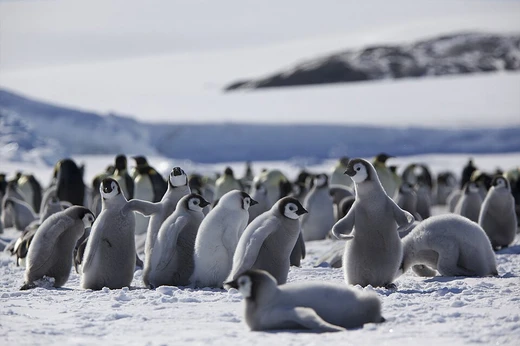
Swarm behaviour, or swarming, is a collective behaviour exhibited by entities, particularly animals, of similar size which aggregate together, perhaps milling about the same spot, moving en masse, or migrating in some direction. It is a highly interdisciplinary topic. As a term, swarming is applied particularly to insects, but can also be applied to any other entity or animal that exhibits swarm behaviour, including birds (flocking or murmuration), tetrapods (herding), fish (shoaling or schooling), and even phytoplankton (blooms). By extension, the term is applied to inanimate entities such as robot swarms, earthquake swarms, or star swarms.
- field
- Collective behaviour, active matter physics, mathematical modelling, swarm intelligence
- key_concepts
- Self-organization, stigmergy, swarm intelligence, topological vs. metric interaction rules
Lore & Background
Many subsequent models implement these rules via concentric zones around each animal: a zone of repulsion, a zone of alignment, and a zone of attraction. The shape of these zones is affected by the sensory capabilities of the animal, such as the visual field of birds or the lateral lines of fish. However, recent studies of starling flocks have shown that each bird modifies its position relative to the six or seven animals directly surrounding it, based on a topological rather than a metric rule.
Reader's Guide
Swarm behaviour is significant as a phenomenon studied across disciplines including biology, physics, mathematics, and artificial intelligence. From a mathematical perspective, it is an emergent behaviour arising from simple rules followed by individuals, without any central coordination. Active matter physicists study swarming as a non-equilibrium thermodynamic phenomenon, comparing it to superfluids in the context of starling flocks. The concept of emergence—that properties at a higher level are not present at lower levels—is a basic principle behind self-organizing systems like ant colonies, where each ant reacts to local stimuli and chemical trails. Algorithms such as ant colony optimization, inspired by ant behaviour, have been effective for solving discrete optimization problems. The field continues to explore both natural and artificial swarms, with models using either Lagrangian (agent-based) or Eulerian (field-based) approaches.
Did You Know?
- Recent studies of starling flocks show that each bird interacts with the six or seven animals directly surrounding it, based on a topological rule rather than a metric one.
More in Ecology And Behavior 25-38
Elsewhere in the Ecology And Behavior universe
Spotted an error? Know more?
This is a living reference — every entry is fact-audited, and reader corrections feed straight into our audit queue. Suggest an edit · See this site's audit record